
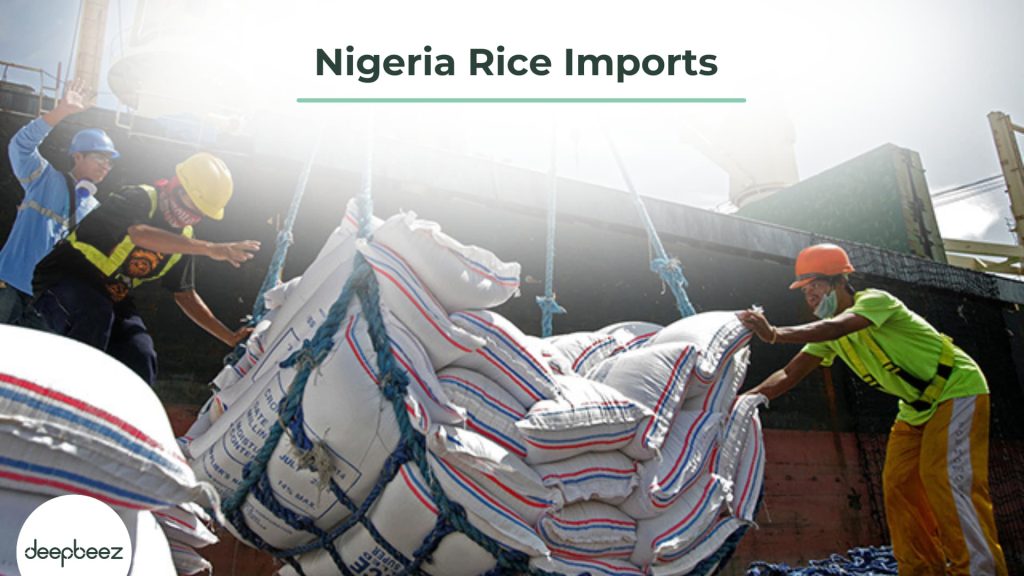
Nigeria’s rice import market tells an interesting story of international trade dependencies and emerging supply chain trends. In 2023, the country imported $7.26 million worth of rice, positioning itself as a significant player in the global rice trade despite being primarily known as an oil-producing nation. Here’s a list of Nigeria rice imports. If you are importing rice to Nigeria, you need to find the most accurate HS code for your product. If you are still unsure about it, you can use Deepbeez HS Code Search Tool to make sure that everything is on track.
List of Nigeria Rice Imports
Nigeria ranked as the 158th largest rice importer globally out of 223 countries in 2023. While this might seem modest, it’s important to note that rice represented the 509th most imported product out of 1,184 total imported goods categories in Nigeria, indicating the country’s diverse import portfolio.
| Country | Import Value | Percentage of Total |
| India | $5.9M | 81.3% |
| United Arab Emirates | $743k | 10.2% |
| Thailand | $307k | 4.2% |
| Benin | $101k | 1.4% |
| United States | $95.4k | 1.3% |
Discover More: Largest U.S. Trade Partners; Import and Export Share
7 Reasons Why Nigeria Should Stop Importing Rice
Rice is one of the most consumed staple foods in Nigeria, but the country still relies heavily on imports to meet its demand. According to the US Department of Agriculture, Nigeria imported about two million tones of rice in 2020, despite the government’s claim that it has achieved self-sufficiency in rice production. This is not only a drain on the country’s foreign exchange reserves, but also a threat to its food security and economic development. Here are seven reasons why Nigeria should stop importing rice and focus on boosting its local production.
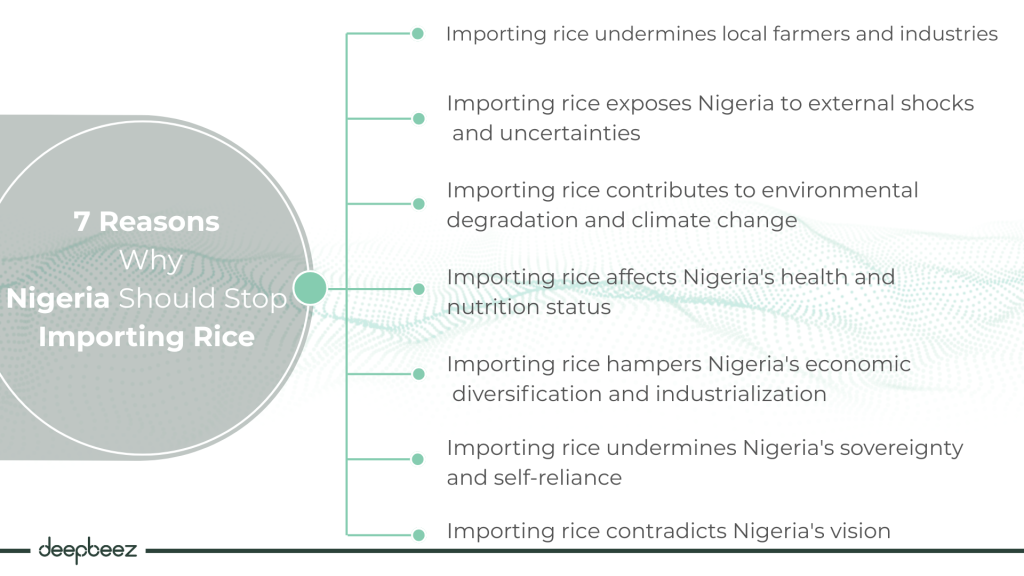
1. Importing rice undermines local farmers and industries
Nigeria has a huge potential for rice production, with about 5.3 million hectares of land suitable for rice cultivation. However, many farmers lack access to improved seeds, fertilizers, irrigation, mechanization, and credit facilities that could enhance their productivity and profitability. Importing rice creates unfair competition for local farmers, who have to sell their produce at lower prices than the imported ones. This discourages them from investing in their farms and reduces their income and livelihood opportunities. Importing rice also affects the local rice processing industry, which suffers from low capacity utilization and high operating costs due to inadequate infrastructure and power supply.